
AI March Madness Bracket Comparison and Analysis
March Madness is about to tip off, and to help you narrow down your picks for who will cut down the nets in a few weeks’ time, we’ve prepared an AI March Madness bracket comparison between the top LLM models. We’ve also compared them to our own sports betting AI, “The Geek.”
Read on to see bracket comparisons between The Geek, ChatGPT, Gemini, Perplexity, Claude, and Grok. We explore how each model predicts first-round upsets, regional winners, and championship picks, and the ways you can learn from their selections.
Key Takeaways from AI March Madness Brackets vs. The Geek
We’ll dive deeper into each model’s path to the final below, but first, here are some key takeaways from our AI March Madness bracket analysis.
- Duke is heavily favored by AI: Every single model picked Duke to reach the Final Four and championship game, with four out of six models selecting the Blue Devils as the eventual champs.
- Most models lean toward safety: First-round upsets were not popular across the six models, with an average of 4.16 for the Round of 64. Perplexity chose zero upsets, while The Geek and ChatGPT chose seven, highlighting varying appetites for risk.
- The Midwest is no-mans-land: No other region shows as much disagreement between AI models, signaling an opportunity for risky bracket picks and upsets in your own brackets.
- (Championship Update) The Geek reigns victorious: If every AI analyzed in this experiment were to enter a traditional bracket contest, The Geek would stand on top with a whopping 135/192 points.
While last year’s tournament saw some of the fewest first round upsets in tournament history, there were still five. In 2024 there were seven, and in 2023 there were also seven. So while selectivity is key, it may be wise to follow the thinking of The Geek and ChatGPT, who have chosen seven first-round upsets when making March Madness predictions.
How We Compared AI March Madness Brackets
When comparing AI March Madness brackets, we looked for key areas like how many upsets each model chose and at what point in the tournament. The most common first round upsets typically come from 11th seeds historically, which have a 62–98 record against 6-seeds.
We also looked at which teams the models chose to pull off upsets, plus factored in how successful they expected top seeds to be. Comparing the five models to the 10,000 simulations run by The Geek is also covered further in each bracket below.
Here’s what our own model produced:
The Geek’s March Madness Bracket:
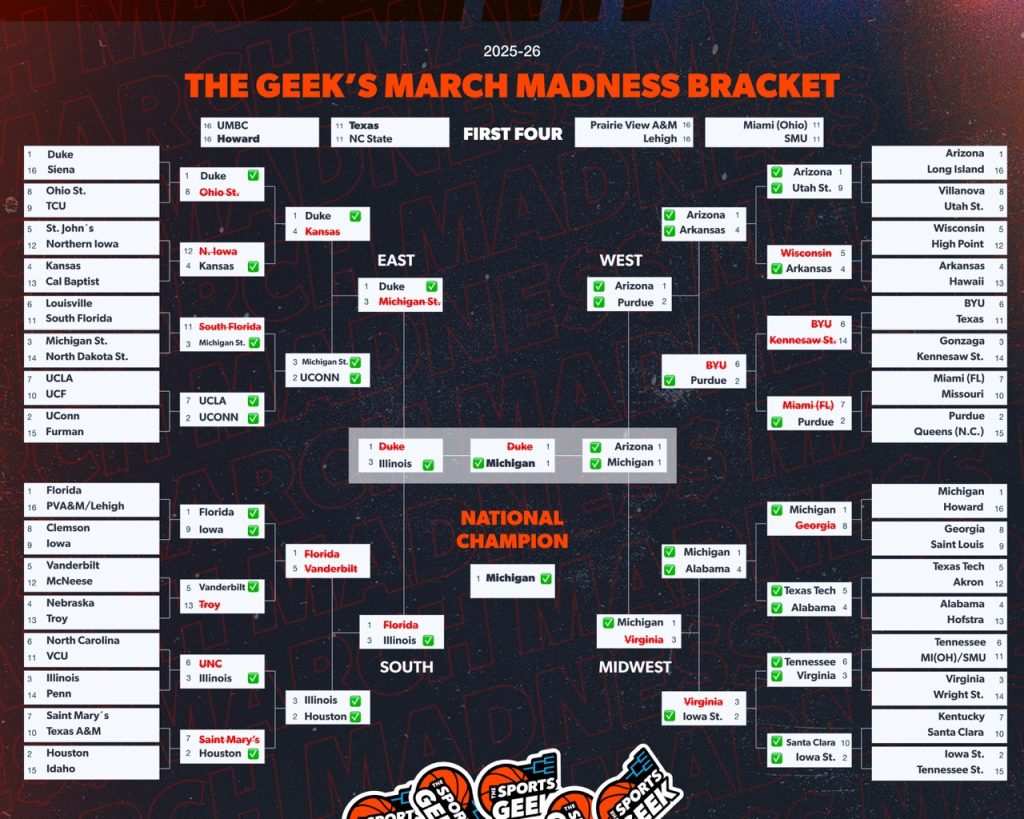
The Geek’s March Madness Picks
The Geek’s bracket leaned heavily on top seeds making deep, controlled runs, with all four #1 seeds (Duke, Florida, Arizona, Michigan) advancing far into the tournament. Unlike some riskier models, this bracket balanced a few early upsets with a very chalk-heavy back half, ultimately projecting stability in later rounds.
If The Geek had entered a traditional bracket with these picks, it would have gone 42/63 for a total of 135 points, the most of any AI by a large margin in our analysis.
Notable Upsets
The Geek called several first-round upsets, particularly in the East and South regions. Double-digit seeds like South Florida (11), Northern Iowa (12), and Troy (13) were picked to advance early, alongside Saint Mary’s (7) over Houston (2), which stands out as a major swing. In the West, Kennesaw State (14) and BYU (6) were highlighted as bracket disruptors, while the Midwest featured Santa Clara (10) and Virginia (3) making noise. Despite these early risks, most Cinderella runs were cut short before reaching the Elite Eight.
Sweet Sixteen Updates
Through the first two rounds, The Geek’s bracket held strong thanks to its reliance on top seeds advancing. All four #1 seeds remained alive entering the Sweet Sixteen, along with solid mid-tier picks like Illinois and UConn. While a few upset picks failed to materialize, the core structure of the bracket remained intact. This positioned The Geek as a strong contender heading into the later rounds, with minimal damage to its championship path.
Final Four Updates
By the Final Four, The Geek’s strategy of favoring elite teams paid off, successfully landing multiple high seeds in the semifinals. Michigan and Arizona held firm on one side, while UConn toppled Duke to continue its dominant run through the East. Illinois emerged as a strong presence from the South, validating its deep-run potential. With three of four projected contenders still alive late, The Geek remained in excellent position compared to more volatile brackets.
NCAA Championship Updates
The championship matchup featured Michigan and UConn, two of the most consistent teams in the bracket. While UConn’s path was dominant, Michigan proved to be the more complete team down the stretch. The Geek ultimately projected Michigan to cut down the nets, securing the national title in a matchup of powerhouse programs. This result capped off a largely chalk-driven bracket with just enough early chaos to stay competitive.
Highlights
- First Round Upsets: South Florida, Northern Iowa, Troy, Saint Mary’s, Kennesaw State, Santa Clara
- Region Winners: Duke, Illinois, Arizona, Michigan
- Final 2: Duke, Michigan
- Champion: Michgan
ChatGPT’s AI March Madness Bracket:

ChatGPT’s March Madness Picks
Starting with ChatGPT, this LLM chose a variety of top seeds ranging from 1–3 to make deep runs. It chose all four #1 seeds (Duke, Florida, Arizona, Michigan) to reach the Elite Eight, but only Duke to reach the semifinals and eventually win the tournament.
If ChatGPT had entered a traditional bracket contest with these picks, it would have finished 33/63 for a meager 51 points. This is the worst of any LLM surveyed, so maybe steer clear from Chat for next year’s bracket.
Notable Upsets
ChatGPT’s March Madness predictions included some of the most first-round upset picks, with seven. Notably, the biggest upsets it chose were UCF (10), South Florida (11), and Northern Iowa (12) in the East Region. In the West, there was only one double-digit seed advancing: 12-seed High Point. The South had McNeese (12) and VCU (11), and in the Midwest, Hofstra (13).
ChatGPT’s furthest-progressing underdogs were High Point and VCU, which it predicted would both be eliminated in the Round of 16.
Sweet Sixteen Updates
After the first two rounds, ChatGPT earned accuracy scores of 65% and 56% in the first and second respectively. It has already lost one of its Final Four picks (Gonzaga) and sits lowest of all models with 30/48 correct picks. As other LLMs have chosen 1 seeds to make the Finals or win, there will need to be a miracle for ChatGPT to finish atop the AI podium at the end of the tournament.
Final Four Updates
ChatGPT’s bracket is officially busted. After failing to predict any of the Final Four correctly, ChatGPT will finish at the bottom of all AI models we reviewed. This performance is largely due to Duke’s collapse against UConn, a trend that will be repeated throughout most models, but even still; ChatGPT finishes with a 55% accuracy score for the entire tournament. Safe to say this is not the LLM to go to for next year’s bracket.
Highlights
- First Round Upsets: Northern Iowa, South Florida, UCF, High Point, McNeese, VCU, Hofstra
- Region Winners: Duke, Houston, Gonzaga, Iowa St.
- Final 2: Duke, Iowa St.
- Champion: Duke

The Geek vs. ChatGPT
When it comes to upsets chosen, The Geek and ChatGPT have a comparable number, with seven each. However, Northern Iowa and South Florida are the only overlapping underdogs chosen. While both models had a similar number of underdogs in the first round, none of The Geek’s were predicted to make it past the Round of 32.
The final four differs quite a bit, with only Duke being the same for both models. The Geek predicted three 1-seeds making the Final Four and Michigan emerging victorious, while ChatGPT chose Duke.
Gemini’s AI March Madness Bracket:
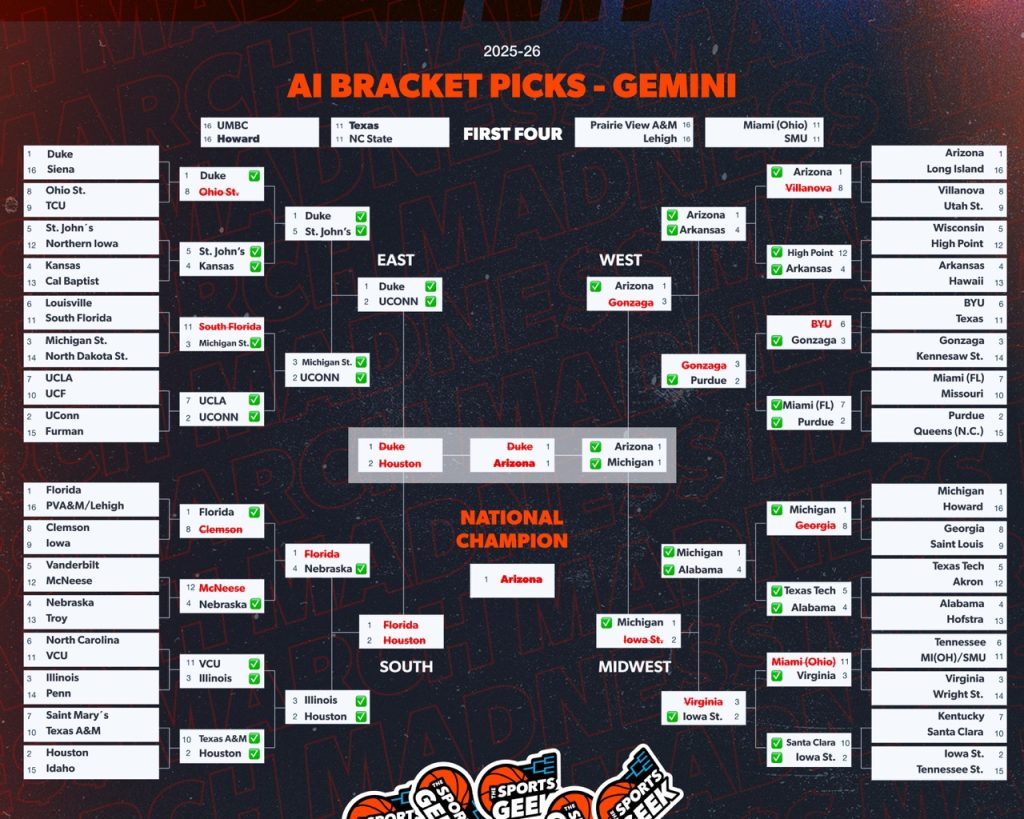
Gemini’s March Madness Picks
Gemini has chosen nearly every top seed going deep, with Duke, Arizona, and Michigan all reaching the Final Four. Florida, the last remaining one-seed, was predicted to get knocked out in the Elite Eight. The Arizona Wildcats were chosen to win in what would be their first national championship since 1997.
In a normal bracket contest, Gemini would have finished 43/63 for a total of 82 points, a below average score that is heavily impacted by failing to predict the final four or championship games.
Notable Upsets
Gemini’s March Madness picks included six first round upsets, all of which happen to be double-digit seeds. The biggest underdogs chosen was the twelfth-seed High Point in the West and McNeese in the South. However, the longest seed to make the Sweet 16 was 5-seed St. John’s, showcasing a lower risk tolerance.
Sweet Sixteen Updates
Gemini’s approach of favoring underdogs has paid off so far, most impressively with High Point’s surprise win in the Round of 64. This model sits at 77% total accuracy, and still has all of its Final Four predictions to look forward to. Gemini is currently second-overall in this competition.
Final Four Updates
In terms of accuracy, Gemini ranks second amongst all AIs in this competition, second only to Claude. Coming into the Final Four with 43/60 picks correct (71.67% accuracy), Gemini relied on a few solid underdog upset wins to propel it forward before settling down for a relatively safe end to the tournament. Duke being eliminated means it has already lost one of these Final Four predictions, but Arizona could still pull through to deliver it a successful championship performance.
Highlights
- First Round Upsets: South Florida, High Point, McNeese, VCU, Miami OH, Santa Clara
- Region Winners: Duke, Michigan, Arizona, Houston
- Final 2: Duke, Arizona
- Champion: Arizona
The Geek vs. Gemini
The Geek and Gemini are nearly identical in their final four selections, with both choosing Duke, Arizona, and Michigan to be still standing. Similar to The Geek, who went against the grain by choosing Michigan instead of Duke, Gemini chose Arizona.
Both models have chosen South Florida and Santa Clara to pull off first round upsets. The Geek’s lowest-ranked team to make the Sweet 16 is 6-seed BYU.
Grok’s AI March Madness Bracket:

Grok’s March Madness Picks
Grok’s March Madness AI predictions feature a Final Four matchup between two top seeds, with a #1 facing a #2 on both sides. Predicting the one-seeds will win their matchups, Grok believes Duke and Arizona will meet in the final, with Duke emerging victorious. Grok heavily favors top seeds, with the Elite Eight being composed of seven teams ranked 1st or 2nd.
In a normal bracket pool, Grok’s picks would have been 41/63 for a total of 72 points, lacking a bit of star power thanks to a miserable performance in the Elite Eight and beyond.
Notable Upsets
Grok chose the fewest upsets of all the models tested, selecting just one first-round upset: 11-seed play-in winner Texas over BYU. And that’s about the biggest talking point we have. According to Grok, the Longhorns don’t get past Gonzaga in the Round of 32, and no team ranked below a 4-seed is seen in the Sweet 16.
Sweet Sixteen Updates
Grok comes in at the middle of the pack in our AI March Madness bracket analysis, boasting a decent average of 75% accuracy. Thanks to its upset-averse approach, xAI’s flagship LLM will be cheering for the favorites in each of its upcoming matchups. It had the second best Round of 32 performance, with 12/16 correct, right behind Gemini’s 13/16.
Final Four Updates
The Sweet Sixteen went decently well for Grok, predicting 50% of matchups correctly. But unfortunately, this AI’s performance faltered heavily in the Elite Eight, selecting only 1/4 games correctly. Like other AIs in this analysis, losing Duke means it will not make a successful championship pick. Selecting 41/60 matchups correctly so far means Grok will finish somewhere around the sub-70% mark for accuracy, a solid showing overall.
Highlights
- First Round Upsets: Texas
- Region Winners: Duke, Houston, Arizona, Iowa St.
- Final 2: Duke, Arizona
- Champion: Duke
The Geek vs. Grok
The Geek has chosen a more realistic first-round upset total in seven. It’s unlikely that only one upset takes place as chosen with Grok, therefore there are few points to compare there.
Both models have a 1 vs 1 in the final, but The Geek has chosen Michigan and Grok has Duke.
Perplexity’s AI March Madness Bracket:

Perplexity’s March Madness Picks
Perplexity chose all four 1-seeds to reach the Final Four, with the nation’s top-ranked team Duke, winning it all. For all of the favorites chosen, notably, the model’s Elite Eight featured four 1 vs 3 matchups. This model also took some urging to make predictions, as it was hesitant to provide “guesswork” for each game without live stats.
Similar to the other AIs above, Perplexity would have gone 40/63 in a typical bracket pool, earning only 77 points. This lines up with other AI scores, but does not demonstrate reliability moving into next year.
Notable Upsets
Perplexity’s LLM March Madness bracket predictions were some of the safest picks among the six models. Perplexity chose zero upsets prevailing in the first round. The furthest prevailing mid-ranked team comes in the South, with 6-seed Illinois making it to the Sweet 16.
Sweet Sixteen Updates
Perplexity took a pretty major hit with the loss of Florida, becoming one of two AI’s that is now missing a Final Four prediction (alongside ChatGPT). Thankfully, it’s approach of zero upsets in the first round gave it a decent showing, coming in at 70.8% accuracy overall for a 4th place finish heading into the Sweet Sixteen.
Final Four Updates
Perplexity had 50% accuracy in both the Sweet Sixteen (4/8) and Elite Eight (2/4) rounds, showcasing the lopsidedness of March Madness perfectly. In these later rounds, higher accuracy becomes more difficult, and as another AI that chose Duke as its champion, it will not have many remaining opportunities to increase its record. For the time being, it is tied with The Geek at 66.77% accuracy, with The Geek having a leg-up in 3/4 correct Final Four Predictions.
Highlights
- First Round Upsets: None
- Region Winners: Duke, Arizona, Michigan, Florida
- Final 2: Duke, Arizona
- Champion: Duke
The Geek vs. Perplexity
You’re probably safer choosing a March Madness betting strategy that mirrors something closer to The Geek’s predictions with seven underdogs. Since the tournament went to 64 teams in 1985, there has never been zero upsets.
Still, both brackets have confidence in the 1-seeds, with three (The Geek) and four (Perplexity) making the Final Four. Perplexity has chosen Duke, and The Geek, Michigan.
Claude’s AI March Madness Bracket:

Claude’s March Madness Picks
The Claude March Madness AI bracket is among the four models who chose Duke to win the title. It’s also one of several to take three 1-seeds reaching the Final Four. The only 2-seed in that group is Houston, whom it has taking out Florida in the Elite Eight.
Claude had one of the better scores in a traditional bracket pool system, earning 45/63 correct picks (the most of any AI analyzed) and a total of 97 points. It comes in second, beat out by a fair margin by the Geek, but shows that it has some depth to rely on for future research.
Notable Upsets
With four first round upsets, Claude’s AI bracket represents a very balanced portfolio — not too aggressive, but not conservative either. The model hasn’t taken anything too outrageous, with three 9-seeds prevailing. Its riskiest pick is #11 VCU upsetting #6 North Carolina in the South Region, which was also chosen by 50% of the models tested.
Among all of the models, Claude did have one of the more interesting Elite Eight picks, with a 6-seed, BYU, going deep and eventually falling to Arizona.
Sweet Sixteen Updates
Claude is currently the top performing AI of our analysis, boasting a 79.2% accuracy so far. The few upsets it selected ended up working in its favor, and will be the AI that the others are attempting to catch up with in this upcoming round.
Final Four Updates
Although it came through the Sweet Sixteen and Elite Eight with average scores of 50% accuracy in each round, Claude still enters the Final Four in first place among all AIs analyzed. With 44/60 picks correctly chosen, it’ll be interesting to see if the AI’s final possible prediction of Michigan in the finals will come true. This is the only remaining pick to be made for Claude, and it looks primed to finish atop the AI podium.
Highlights
- First Round Upsets: Utah St., Iowa, VCU, Saint Louis
- Region Winners: Duke, Houston, Michigan, Arizona
- Final 2: Duke, Michigan
- Champion: Duke
The Geek vs. Claude
Claude and The Geek have one comparable upset pick with 9-seed Utah St. upsetting 8-seed Villanova in the first round in the West Region.
The models have both taken Duke, Arizona, and Michigan for the Final Four and both have a Duke-Michigan final, however, they’ve taken opposite sides.
Comparing AI March Madness Brackets
After comparing five LLM brackets alongside The Geek’s AI picks, it’s clear that most models lean heavily toward favorites in the 2026 NCAA tournament.
Four of the six models selected either three or four #1 seeds to reach the Final Four. Considering a 1-seed has won the title 26 times, this approach isn’t unreasonable.
However, we recommend following a more balanced strategy similar to The Geek, ChatGPT, or Gemini, which include six to seven first-round upsets.
Biggest Similarities Across LLMs
Leaning on top seeds to go far, especially with the Duke Blue Devils, was a prevailing theme when comparing LLM March Madness brackets. Here are some more:
Biggest Differences Across LLMs
Meanwhile, a varying number of upset picks, and how far the models chose longshots to progress, highlight a few differences among the brackets.