

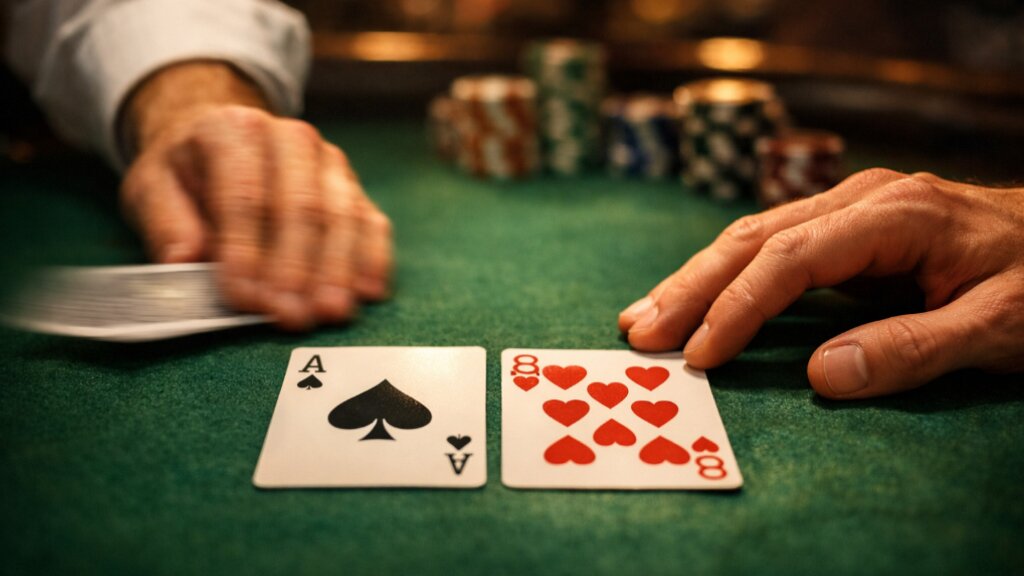
A push in blackjack occurs when the player and the dealer end with the same point total for a given hand. Casino rules for handling a push vary and understanding how these situations are resolved is important to your overall strategy.
I discuss the basics of pushes in blackjack, including how they work and how often they occur, in the guide below. Also, I address how pushes affect specific situations, such as split or double hands.
What Is a Push in Blackjack?
The term “push” in blackjack applies when the dealer and player tie by having the same points value.
A push can happen with any hand value. However, since the dealer hits until they reach their minimum, usually 17, pushes typically happen between 17 and 21-point hands.
What happens next will depend on the casino’s rules for black pushes. At most modern casinos, the hand is ruled a tie, and your initial stake is returned to you.
So, if you placed a $10 ante on a hand that ends in a push, you will get your $10 back.
Some casinos have less player-friendly rules though, and the table you are playing at could have an automatic tiebreaker in favor of the dealer. At these tables, you lose your ante wager if the round ends in a push.
Probabilities for a Push in Blackjack
The chances of a blackjack round ending in a push are approximately 8.5%, although, the number varies a bit depending on the table rules. See the table below for the probability of a push with specific hands in blackjack.
Player and Dealer Both Have:
Probability
Natural Blackjack
0.23%
21
2.3%
20
2.5%
19
1.5%
18
0.7%
17
0.5%
The following factors that can change the exact odds of a push occurring:
-
- The odds of a push decrease as the number of decks increases
- The chances of pushing increase if the dealer hits on a soft 17
- Hitting on a soft 17 vs. a 2 decreases the odds of a push
- Standing on 12 vs. a 2 decreases the odds of a push
Can Doubled and Split Bets Push in Blackjack?
Yes, doubled and split bets can both push in blackjack.
On doubled hands, you will receive your initial ante and your increased wager back if the hand ends in a push.
Split hands are slightly different because they are played separately. One can push, and the other can still win or lose depending on the dealer’s total.
It is also worth noting that a split hand ending in 21 is not a natural blackjack. As a result, it is significantly more likely to end in a push than a true natural is.
Is Pushing in Blackjack Good or Bad?
A push in blackjack can be a double-edged sword, as you get your wager back but do not win any additional money. On a weak hand, such as a 17, pushing is good because you were unlikely to win anyway. However, pushing on strong hands, such as a natural blackjack, is frustrating.
Overall, since pushing prevents you from losing money to the casino’s house edge, it is technically a positive outcome. Check out our guide to the top blackjack casinos to learn more about the rules and strategies for playing 21 online.


You must be logged in to comment. Don't have an account? Sign up today.