


The rapid rise of artificial intelligence (AI) is transforming industries across the globe, and sports betting is no exception. From smarter odds-making, and personalized tips that help bettors implement systems, new AI betting technologies are reshaping how bettors make their predictions.
Let’s take a deep dive into the modern AI betting technology to see how it’s shaping the betting experience for both sportsbooks and users.
What Are AI Betting Technologies and How Do They Work in Sports Betting?
AI betting technologies are computational systems that use machine learning, natural language processing, computer vision, and automated algorithms to analyze sports data and generate predictions.
This allows bettors to make more informed, data-driven decisions when placing their wagers. Instead of relying on limited personal research that could take hours, they can tap into models that evaluate hundreds of data points in just seconds.
What might take a human hours of analyzing is handled almost instantly by AI. These systems can also uncover patterns, metrics, and insights that a person might overlook, providing a deeper foundation for betting strategies.
Let’s break down the most common technologies that enable AI betting picks.
1. Machine Learning Models for Prediction and Pattern Recognition
Machine learning models are increasingly used in sports analytics to predict game outcomes, point spreads, and totals by analyzing large amounts of historical data.
These models rely on supervised learning algorithms, meaning they are trained on past results. Common algorithms include random forests, gradient boosting machines, and neural networks, each offering different strengths in pattern recognition and prediction accuracy for sports betting picks.
The training process begins with collecting historical sports data such as team performance, player statistics, injuries, weather conditions, betting lines, and home vs. away trends. The model studies relationships between these variables and actual game results to identify patterns that humans may overlook.
Once trained, the algorithm can evaluate new matchups and generate probability-based predictions for winners, scoring margins, or total points.
Random forests operate by combining many decision trees to improve reliability, while gradient boosting models refine predictions by learning from previous errors. In conjunction, neural networks are especially powerful for detecting complex, nonlinear relationships in large datasets that can be difficult for a human to compute.
The table below highlights common machine learning model types and their practical betting applications:
| Model Type | Strengths | Weaknesses | Typical Betting Applications |
|---|---|---|---|
| Linear Regression | Simple, fast, highly interpretable, strong baseline model; speed and efficiency | Assumes linear relationships, sensitive to outliers, misses complex interactions; matchups determined by nonlinear trends, including injuries, fatigue and chemistry | Point spread estimates, totals modeling, baseline projections |
| Random Forest | Handles nonlinear relationships, reduces overfitting, robust with mixed data types; helps identify trends humans may misidentify (travel, matchups styles, pace, fatigue) | Less interpretable, can be computationally heavy, less precise for fine-grained outputs; struggles with live betting predictivity where conditions can change quickly | Moneyline prediction, situational edges, matchup analysis |
| Gradient Boosting Machine (GBM) | Very high predictive accuracy, captures complex nonlinear patterns, strong performance on structured data | Prone to overfitting if not tuned properly, slower training, harder to interpret than linear models; difficult to adapt to lineup changes, coaching changes, and injuries | Sharp betting models for spreads/totals, player props, market inefficiency detection |
| Neural Network | Excellent at deep pattern recognition, handles very large datasets, captures complex interactions | Requires large data, high compute cost, “black box” nature that makes it difficult for bettors to analyze | Advanced simulations, live betting models, prop betting, large-scale prediction systems (futures) |
In general, the training process for these models involves inserting thousands of past games containing input features such as team efficiency ratings, player performance metrics, injury reports, matchup history, pace of play, and betting market data.
The algorithms then learn how these variables relate to outcomes like wins and losses, point differentials, or total scores. During training, the models continuously adjust internal parameters to minimize prediction errors and improve future accuracy. The models are fluid and are likely to improve in time.
Machine Learning Betting Academic Research
While research remains ongoing, a study by the National Library of Medicine revealed that their best model (ACC) yielded a ROI of 54.73%. The weighted precision across all models ultimately led to a success rate of 51.07%.
However, the research warned that it’s important to note that model calibration and how the system is implemented is key to generating the best results. Simple raw predictivity is unreliable if the user doesn’t automatically translate to a successful ROI.
In a separate study by the Journal of Sports Analytics that focused on tennis betting, they discovered that there are slight benefits to using machine learning for sports predictions. Using a wide range of models (logistic regression, random forests, neural networks, and gradient boosting), the study finds that prediction accuracy across all methods typically peaks around 70%, but this does not necessarily translate into strong betting profits.
The key result is that betting market odds already contains most of the predictive information, meaning that adding additional player, match, or contextual data provides only small improvement over bookmaker-implied probabilities.
Nevertheless, those small edges can be the difference between producing a positive ROI and better than a 52.4% success rate (required for a profit) against the spread (ATS) at -110 odds.
2. Natural Language Processes for New and Social Media Analysis
In a betting context, Natural Language Processes (NLP) collect and interpret text from news articles, social media, injury reports, press conferences, and beat writer reports.
One key application is sentiment analysis, which measures public perception of teams, players, or games. By analyzing positive or negative language, NLP systems can detect shifts in narratives, such as rising confidence in a team or growing concern about a player’s form.
These narrative changes can sometimes influence betting markets or reveal information that has not yet been fully reflected in odds.
NLP is also powerful for information extraction, where algorithms scan text in real time to identify critical updates like injuries, lineup changes, weather conditions, or coaching decisions. This allows models to react faster than traditional data pipelines and incorporate breaking news into predictions.
Another advanced use is distinguishing “sharp” vs. “public” sentiment. NLP systems analyze language patterns, posting behavior, and source credibility across sportsbooks, forums, and social media to separate informed betting opinions from casual or biased public sentiment. This can help identify where market inefficiencies may exist.
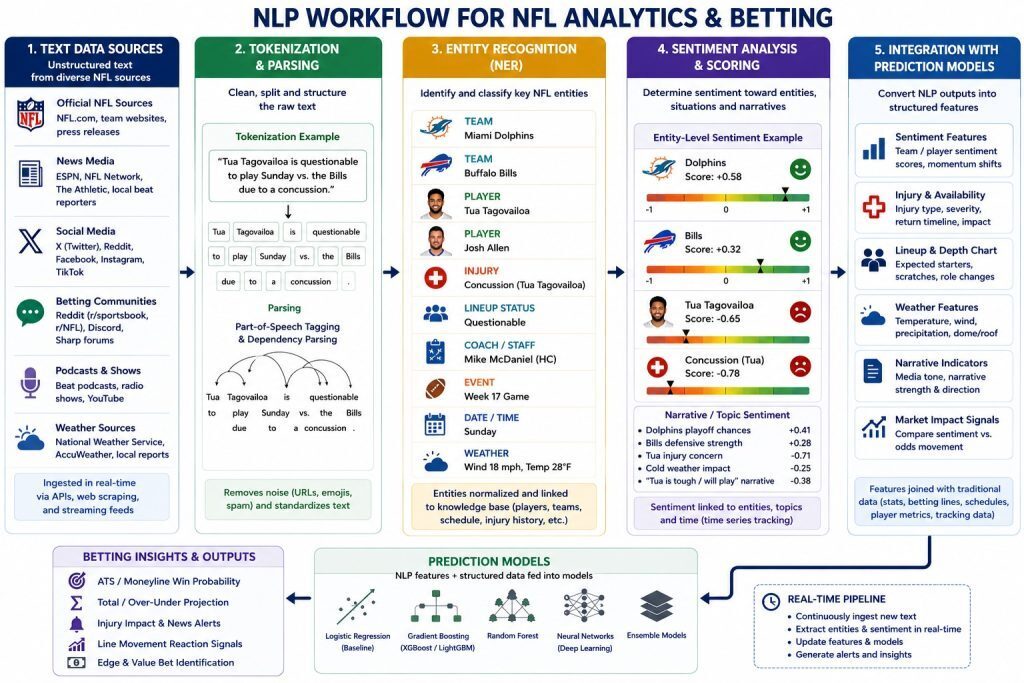
However, NLP has important limitations. It struggles with sarcasm, ambiguous context, and misinformation, which are common in sports discussions. Additionally, social media sentiment often reflects emotional bias rather than predictive insight, meaning it does not always translate into betting value.
In an online world where sarcasm and misinformation are rampant, this must be taken into consideration when using this predictive AI betting technology.
Key NLP Research and Data
Modern sportsbooks and quantitative betting firms use automated NLP pipelines to monitor social media, injury reports, and journalist feeds in real time. These systems apply tokenization, named-entity recognition, and event extraction to detect injuries, lineup changes, or suspensions within seconds.
Because injury news directly affects team strength estimates, online sportsbooks often adjust betting odds within minutes of credible reports appearing online. Therefore, it can be a battle between bettors and sportsbooks on whose NLP model can collect and facilitate information more quickly.
Hong and Skiena’s study, The Wisdom of Bookmakers, analyzed Twitter, blogs, and news sentiment alongside NFL betting spreads and found weak to moderate correlations. Their findings suggest that while public sentiment can slightly influence market behavior, it is generally too inconsistent to provide a reliable betting advantage.
Likewise, Paul and Weinbach’s research on sentiment bias from 32,000 NBA games between 1981-2012 found that betting lines may reflect public popularity and emotional reactions, but these effects used alone rarely translate into sustained profitable strategies.
Additional market-efficiency research based on 3,681 MLB games published in Management Science concluded that sportsbooks rapidly incorporate publicly available information into odds, leaving little opportunity for sentiment-based models to outperform established betting markets. Having said that, there is a window of opportunity for bettors to develop a more precise model than sportsbooks currently have access to.
3. Computer Vision and Player Tracking Data Integration
Computer vision systems are transforming sports analytics by analyzing video footage and player-tracking data to measure performance far beyond traditional box-score statistics.
Modern tracking technologies such as NBA SportVU, NFL Next Gen Stats, and advanced soccer camera systems continuously record player and ball movement throughout games, generating millions of spatial data points in real time.
These systems capture highly detailed metrics including player positioning, acceleration, movement speed, defensive spacing, shot selection quality, passing lanes, tactical formations, and fatigue indicators derived from declining movement intensity.
In basketball, AI models can evaluate the quality of every shot attempt by analyzing defender distance, shot location, player balance, and offensive spacing instead of relying only on basic field goal percentage.
In football, tracking data measures receiver separation, route efficiency, pass-rush pressure timing, and defensive coverage structure. Soccer analytics systems similarly evaluate team shape, pressing intensity, and off-ball movement patterns.
Machine learning models use this tracking data to produce more accurate player and team evaluations than traditional statistics alone. For example, two players may shoot the same percentage, but AI systems can determine which player consistently generates more difficult or higher-value scoring opportunities based on contextual factors invisible in standard box scores.
However, this data is expensive and could cost thousands of dollars a month. It’s also computationally intensive to process, so advanced computer vision analytics are primarily used by professional sports organizations, betting syndicates, and high-level bettors with access to stat tracking databases.
4. Automated Trading Systems and Market-Making Algorithms
Automated betting systems are algorithm-driven programs that place wagers automatically based on predefined rules and data models.
These systems continuously scan sportsbook markets for opportunities such as favorable model predictions, value thresholds, arbitrage situations, or rapid line movements. When specific criteria are met, the algorithm can instantly execute bets without requiring manual input from a human bettor.
Many professional operations also use market-making algorithms similar to those found in financial trading. These systems manage risk, adjust pricing dynamically, and react to incoming betting volume in prediction markets and sportsbooks.
Similarly to high-frequency trading in finance, betting algorithms attempt to identify pricing inefficiencies before the broader market corrects them.
Some of the biggest advantages of automated betting systems are speed and efficiency. Algorithms can process massive amounts of data and respond to odds changes within seconds, or even milliseconds, after sportsbooks post new lines or react to breaking news.
Automation allows professional bettors to capture value before regular bettors can analyze the information and before the market fully adjusts.
Professional betting syndicates often operate highly sophisticated automated infrastructures with direct API access to sportsbooks, enabling rapid wager execution across multiple markets simultaneously.
Casual bettors, by contrast, typically face slower interfaces, betting delays, lower limits, and account restrictions that reduce their ability to scale automated strategies effectively.
To help clarify, find our comparison between manual betting at an online sportsbook versus an automated system that streamlines the process:
| Capability | Manual Betting | Automated Betting Systems |
|---|---|---|
| Reaction Time | Seconds to minutes depending on user attention and analysis speed | Milliseconds to seconds using real-time algorithms |
| Sportsbooks Monitored Simultaneously | Usually a few books manually tracked | Dozens or hundreds monitored continuously through APIs |
| Bet Placement Speed | Manual entry requires confirmation and navigation | Instant automated execution once criteria are triggered |
| Ability to Exploit Line Moves | Often misses fast-moving market changes | Captures value immediately after odds shifts |
| Arbitrage Detection | Difficult to identify consistently in real time | Automatically scans for pricing discrepancies across markets |
| Data Processing Capacity | Limited by human attention and time | Processes massive datasets and live feeds continuously |
| Consistency of Decision-Making | Influenced by emotion, fatigue, and bias | Rule-based execution with no emotional influence |
| Error Rate | Higher risk of typing mistakes, wrong bet sizes, or delayed wagers | Lower operational error when properly configured and debugged |
| Scalability | Difficult to manage large betting volume manually | Can execute large numbers of wagers simultaneously |
| Access to Proprietary Data | Mostly public information | Includes private models, tracking data, and syndicate feeds |
| Infrastructure Requirements | Browser or sportsbook app | Requires servers, APIs, automation software, and monitoring systems |
| Common Users | Recreational and retail bettors | Professional bettors, syndicates, quantitative trading groups |
| Limitations | Slower execution and information lag | Subject to sportsbook limits, API restrictions, and technical failures |
Data Sources and Processing Methods in AI Betting Systems
It’s important to understand that AI betting technologies are only as sharp as the data that is inputted into the model: the garbage in, garbage out principle applies in this case.
Core data inputs typically include traditional statistics:
- Team efficiency ratings
- Player performance trends
- Matchup history
- Pace of play
- Advanced analytics
These are combined with real-time event data like live scoring updates, lineup confirmations, injury reports, referee assignments, and betting line movements.
External variables also play an important role:
- Weather conditions
- Travel schedules
- Rest disadvantages
- Altitude effects
- Scheduling (back-to-back games)
Modern AI betting systems increasingly incorporate alternative data sources as well. These include news articles, press conferences, social media sentiment, betting market activity, and even player-tracking data generated from computer vision systems.
By merging structured and unstructured information, models can identify subtle patterns and market inefficiencies that may not appear in conventional statistics.
Professional betting operations use sophisticated proprietary data pipelines to manage this process. These pipelines continuously collect information from dozens of sources, then clean and validate the data before it reaches prediction models.
This preprocessing stage is critical because inaccurate, delayed, or inconsistent data can severely reduce model performance.
The result is an automated ecosystem where high-quality data flows into machine learning systems in real time, allowing professional bettors and syndicates to react quickly to market changes and maintain a competitive edge.
1. Historical Statistics and Performance Metrics
Historical data forms the foundation of most AI sports betting and prediction models. These datasets typically include team and player statistics collected across multiple seasons, such as win-loss records, scoring averages, offensive and defensive efficiency ratings, shooting percentages, turnovers, rebounding numbers, pace metrics, and advanced analytics.
AI models use this historical information to establish baseline expectations for future performance. By analyzing thousands of past games, the algorithms learn how different variables influence outcomes such as wins, point spreads, or total scores. This allows models to identify recurring statistical patterns that may not be obvious through traditional analysis alone.
For example, AI betting technologies can detect long-term trends involving home-field advantage, fatigue effects, matchup mismatches, or coaching tendencies. Historical data also helps models distinguish between sustainable performance and short-term variance, improving prediction accuracy.
The larger the sample size of data, the more effectively AI systems can recognize meaningful trends and generate reliable forecasts for future sporting events.
2. Injury Reports, Weather Data, and External Variables
External variables play a major role in sports outcomes, but they are much harder for AI systems to quantify than traditional statistics like scoring averages or efficiency ratings.
Factors such as injuries, weather conditions, travel schedules, rest days, altitude, and time-zone changes can significantly influence player performance and team results in ways that are often context-dependent.
Injury data is particularly challenging because official reports are frequently vague, delayed, or strategically misleading. To improve accuracy, advanced AI systems use Natural Language Processing (NLP) to analyze beat writer updates, press conferences, practice participation reports, and social media discussions.
These systems combine real-time news with historical injury-impact data to estimate a player’s true availability and likely performance degradation rather than relying solely on official injury reports.
Weather integration is also critical in outdoor sports such as NFL football, MLB baseball, and golf. AI models analyze variables including temperature, wind speed, precipitation, and humidity to measure how conditions historically affect scoring, passing efficiency, kicking accuracy, ball movement, or player stamina.
Checklist of Key External Variables Monitored by AI Betting Systems
External Variable
Why It Matters
Injury Status
Player absences or reduced effectiveness can significantly alter team strength, rotations, and matchup dynamics
Practice Participation
Limited or missed practices often provide stronger indicators of true player availability than official injury reports
Weather Conditions
Wind, rain, snow, temperature, and humidity heavily affect outdoor sports such as NFL, MLB, and golf
Travel Distance
Long-distance travel increases fatigue and can reduce performance, especially across multiple time zones
Rest Days
Teams on short rest or back-to-back games often show declines in efficiency and player stamina
Altitude
High-altitude environments can impact endurance, pace, and recovery, particularly in basketball and football
Time-Zone Changes
Circadian disruption may reduce player reaction time, energy levels, and overall performance
Referee/Umpire Assignments
Certain officials influence foul rates, game pace, penalty frequency, or scoring environments. It is especially important in baseball for strikes and balls (tight or wide zone).
Motivational Factors
Playoff races, elimination games, rivalry matchups, and revenge spots can alter player intensity and coaching strategy
Lineup Changes
Unexpected starters or rotation adjustments can shift tactical matchups and team chemistry
Coaching Decisions
Scheme adjustments, load management, and play-calling tendencies affect game flow and outcomes
Schedule Spots
Trap games, look-ahead situations, and condensed scheduling can affect focus and energy
Venue Characteristics
Indoor vs. outdoor stadiums, turf type, court dimensions, and crowd environment influence play style
Public Sentiment
Heavy public betting pressure can distort market pricing away from true probabilities
By quantifying these environmental and external effects, models can adjust predictions more accurately for specific game conditions.
Studies on the Impact of Star Player Absences and Weather
Academic research on sports betting markets shows that the absence of a meaningful or “high-value” player causes measurable betting line movement, especially in the NBA and NFL.
A study in Finance Research Letters found sportsbooks and bettors systematically move lines “away from the team with absences,” with larger adjustments tied to higher-value players.
In practical betting markets, this often translates into:
-
- NBA superstars: roughly 2–5 point spread movement
- NFL quarterbacks: sometimes much larger adjustments depending on backup quality.
For weather effects, NFL betting analyses show that high wind is the strongest scoring suppressor. Wind above 15-20 mph significantly reduces passing efficiency and scoring.
AI betting models estimate NFL totals decline approximately:
-
- 5 points at 15-20 mph winds
- 4 points at 20-25 mph winds
- 6+ points in extreme wind conditions
Betting guides and historical market data indicate heavy wind/rain games can shift totals by roughly 3-5 points, especially when precipitation combines with sustained wind.
Do AI Prediction Models Actually Improve Betting Results?
Yes and no. AI betting prediction models should only be considered as a tool for now. It’s important to understand that they are only as sharp as the person building them and inputting the required data.
In short, there is no obvious answer that’s universally true. Results are heavily dependent on scaling and integration by the end user. AI provides advantages in sports betting, but those advantages are far smaller than many marketing claims suggest.
Modern betting markets are highly efficient because sportsbooks and professional bettors already use sophisticated quantitative models. Any profitable pattern identified by AI is often quickly reflected in betting lines as more participants exploit the same information, reducing or eliminating the edge.
As a result, realistic performance expectations are modest. Professional AI betting systems typically target long-term accuracies around 53-56% against the spread with roughly 2-5% ROI. Claims of sustained 60-70% win rates are generally unrealistic or based on selective reporting.
Variance is also enormous in sports betting, meaning even profitable models can experience long losing streaks. Bettors often need hundreds or thousands of wagers before distinguishing genuine skill from randomness, yet many AI tools advertise cherry-picked short-term results.
In practice, AI is most valuable for scanning thousands of markets, identifying small pricing inefficiencies, optimizing bankroll management through methods like the Kelly Criterion, and processing information faster than human handicappers.
Even successful bettors face limitations because sportsbooks increasingly use AI systems to identify profitable accounts and restrict betting limits, making it difficult to scale long-term advantages. As AI betting technologies continue grow, there is room for greater improvement, though.
What Academic Studies Are Saying About AI Prediction Models
As referenced in the National Library of Medicine above, their best machine learning (ML) model hit at a 54.73% clip. Across all models, they achieved a weighted score of 51.07%.
Academic research on sports betting markets consistently demonstrates that these markets are highly efficient, creating a difficult environment for AI prediction systems to win consistently. Typically, betting markets have already incorporated most publicly available information, including injuries, weather, team performance, and betting sentiment.
Consequently, closing lines themselves predict against-the-spread outcomes at approximately 52-53% accuracy, which is close to the break-even threshold after sportsbook commission (“vig”).
Research on professional sports bettors shows similarly modest but meaningful long-term results. Multiple studies and betting market analyses indicate that successful professional bettors and betting syndicates generally achieve sustained win rates of roughly 53-55% against the spread, producing estimated long-term returns on investment (ROI) of approximately 2-5%.
Although these numbers may appear small, they are considered extremely strong in efficient markets where even a 1-2% edge can generate substantial profits over thousands of wagers.
In conclusion, profitable sports betting depends on maintaining small statistical advantages over very large sample sizes rather than achieving unrealistic 60-70% win rates often advertised by commercial systems and AI betting models.
How to Evaluate AI Betting Tools and Avoid Scams
The market for AI sports betting tools has grown rapidly in recent years, but it is also flooded with services making exaggerated or misleading claims. Many platforms advertise unrealistic win rates, guaranteed profits, or “secret” algorithms capable of consistently beating sportsbooks.
In reality, a significant number of these services are either ineffective, heavily cherry-pick results, or operate as outright scams designed to profit from subscriptions rather than successful betting performance.
Because sports betting markets are highly efficient, any claim of sustained 60-70% accuracy should immediately be treated with skepticism.
Evaluating AI betting tools requires a critical understanding of performance metrics and statistical variance. Bettors should examine whether results are independently verified, whether records include all wagers over large sample sizes, and whether reported returns account for sportsbook commission and realistic betting limits.
Transparency around methodology, data sources, and model limitations is also essential when assessing credibility.
The following subsections outline practical frameworks for evaluating AI betting services responsibly. These include identifying common red flags, asking key evaluation questions, understanding transparency and verification standards, and recognizing important legal and regulatory considerations.
Together, these guidelines help distinguish legitimate analytical tools from misleading marketing claims and reduce the risk of relying on ineffective or deceptive betting systems.
Red Flags in AI Betting Marketing Claims
One major red flag in the AI betting industry is the use of vague claims about “proprietary algorithms” without any meaningful explanation of methodology.
Legitimate services usually describe their general approach, such as using machine learning models, historical databases, market analysis, or statistical validation methods, even if they do not reveal their exact code or formulas. Completely secretive systems often rely more on marketing than actual predictive value.
Another warning sign is heavy reliance on testimonials, screenshots, or anecdotal success stories without independently verified records.
Winning tickets prove nothing because losing bets can easily be hidden. Credible services should provide transparent, time-stamped historical performance data verified by third-party tracking platforms over large sample sizes.
Scam services also frequently use “limited-time offers,” “exclusive access,” or countdown timers to pressure customers into buying before conducting proper due diligence. Similarly, services demanding large upfront payments without free trials, refunds, or performance-based pricing should be approached cautiously.
Any platform claiming access to “insider information,” “fixed games,” or guaranteed outcomes is a major legal and ethical red flag. These claims are typically fraudulent and sometimes associated with illegal activity.
Finally, bettors should avoid services that display only winning picks while concealing losses or overall ROI. Cherry-picked results create a misleading impression of profitability and prevent accurate evaluation of long-term performance.
Checklist of Red Flags When Evaluating AI Betting Services
Red Flag
Why It’s Concerning
Guaranteed Win Rates
No legitimate betting system can guarantee profits or consistently achieve unrealistic 60-70% accuracy
No Methodology Disclosure
Credible services explain their general approach, data sources, and validation methods without revealing proprietary code
Pressure Tactics
“Limited-time offers” or “exclusive access” claims are often used to prevent proper research and due diligence
No Verifiable Track Record
Transparent services provide independently verified, time-stamped betting records across large sample sizes
Insider Information Claims
Claims about “fixed games” or insider access are usually fraudulent and potentially illegal
Cherry-Picked Results
Showing only winning bets while hiding losses creates a misleading picture of profitability
Unrealistic ROI Claims
Promises of massive guaranteed returns ignore the reality of efficient betting markets and variance
No Long-Term Sample Size
Small winning streaks prove little; legitimate evaluation requires hundreds or thousands of tracked bets
No Refunds or Trial Periods
Reputable services often provide trials, transparent pricing, or refund policies
Anonymous Operators
Lack of identifiable owners, analysts, or company information reduces accountability
No Independent Reviews
Absence of credible third-party discussion or verification is a warning sign
Excessive Marketing Hype
Overly aggressive social media promotion often prioritizes subscriptions over actual betting performance
No Online Presence or History
Newly created websites with little reputation or historical content should be approached cautiously
Fake Testimonials or Screenshots
Screenshots of winning tickets can easily be manipulated or selectively displayed
Claims of “Never Losing”
Even the best professional bettors experience losing streaks due to natural variance


You must be logged in to comment. Don't have an account? Sign up today.