


How much do NFL players make after taxes? To provide an accurate NFL paycheck breakdown, we must calculate how much football players take home after paying taxes.
While contracts worth hundreds of millions of dollars dominate the headlines, NFL player’s salaries can look considerably different after Uncle Sam and various state and local governments take their share.
For this analysis, we’re using a $1 million NFL salary baseline and calculate how much NFL players actually take home on every team during the 2026-27 NFL season. If you wish, you can extrapolate this salary to a larger amount to calculate a more expensive contract.
And there’s a major reason why the 2026-27 season is particularly interesting: the NFL’s schedule features a record nine international regular-season games across four continents, seven countries, and eight stadiums.
Here’s the top 10 teams where players make the most after taxes, but we break down the rest below.
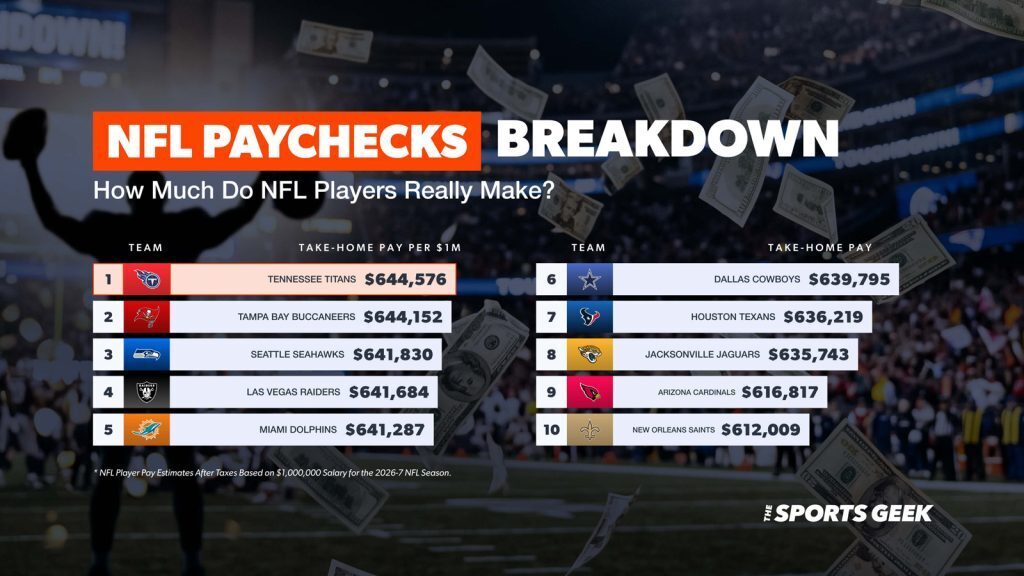
So, how much is $1 million worth to players on every NFL team? Let’s find out!
NFL Salaries After Taxes – Paycheck Breakdown for All Teams
*NFL Player Pay Estimates Based on $1,000,000 Salary for the 2026-27 NFL Regular Season.
| Team | Federal Tax | State Tax | FICA | Local Tax | U.S. Jock Tax | Intl. Tax | Take-Home Pay |
|---|---|---|---|---|---|---|---|
| Tennessee Titans | $320,000 | $0 | $33,139 | $0 | $2,284 | $0 | $644,576 |
| Tampa Bay Buccaneers | $320,000 | $0 | $33,139 | $0 | $2,709 | $0 | $644,152 |
| Seattle Seahawks | $320,000 | $0 | $33,139 | $0 | $5,030 | $0 | $641,830 |
| Las Vegas Raiders | $320,000 | $0 | $33,139 | $0 | $5,176 | $0 | $641,684 |
| Miami Dolphins | $320,000 | $0 | $33,139 | $0 | $5,574 | $0 | $641,287 |
| Dallas Cowboys | $320,000 | $0 | $33,139 | $0 | $4,370 | $2,696 | $639,795 |
| Houston Texans | $320,000 | $0 | $33,139 | $0 | $8,680 | $1,961 | $636,219 |
| Jacksonville Jaguars | $320,000 | $0 | $33,139 | $0 | $7,196 | $3,922 | $635,743 |
| Arizona Cardinals | $320,000 | $25,000 | $33,139 | $0 | $5,044 | $0 | $616,817 |
| New Orleans Saints | $320,000 | $30,000 | $33,139 | $0 | $3,380 | $1,471 | $612,009 |
| Carolina Panthers | $320,000 | $39,900 | $33,139 | $0 | $3,096 | $0 | $603,865 |
| Pittsburgh Steelers | $320,000 | $30,700 | $33,139 | $10,000 | $6,379 | $1,471 | $598,310 |
| Denver Broncos | $320,000 | $44,000 | $33,139 | $0 | $5,168 | $0 | $597,693 |
| Chicago Bears | $320,000 | $49,500 | $33,139 | $0 | $3,704 | $0 | $593,657 |
| Cleveland Browns | $320,000 | $26,784 | $33,139 | $25,000 | $2,551 | $0 | $592,526 |
| Indianapolis Colts | $320,000 | $29,500 | $33,139 | $16,184 | $6,710 | $1,961 | $592,506 |
| Cincinnati Bengals | $320,000 | $26,784 | $33,139 | $18,000 | $7,354 | $2,353 | $592,370 |
| Atlanta Falcons | $320,000 | $51,900 | $33,139 | $0 | $3,731 | $2,353 | $588,876 |
| New England Patriots | $320,000 | $50,000 | $33,139 | $0 | $8,005 | $1,551 | $587,305 |
| Kansas City Chiefs | $320,000 | $46,883 | $33,139 | $10,000 | $4,489 | $0 | $585,489 |
| New York Giants | $320,000 | $65,894 | $33,139 | $0 | $3,365 | $0 | $577,602 |
| New York Jets | $320,000 | $65,894 | $33,139 | $0 | $4,074 | $0 | $576,893 |
| Buffalo Bills | $320,000 | $65,894 | $33,139 | $0 | $4,613 | $0 | $576,354 |
| Detroit Lions | $320,000 | $42,500 | $33,139 | $24,000 | $4,018 | $1,551 | $574,792 |
| Green Bay Packers | $320,000 | $68,078 | $33,139 | $0 | $4,333 | $0 | $574,450 |
| Philadelphia Eagles | $320,000 | $30,700 | $33,139 | $37,350 | $8,172 | $1,961 | $568,678 |
| Washington Commanders | $320,000 | $91,525 | $33,139 | $0 | $3,487 | $1,961 | $549,887 |
| Baltimore Ravens | $320,000 | $58,385 | $33,139 | $32,000 | $7,113 | $2,696 | $546,667 |
| Minnesota Vikings | $320,000 | $92,998 | $33,139 | $0 | $7,225 | $2,941 | $543,696 |
| Los Angeles Chargers | $320,000 | $103,837 | $33,139 | $0 | $3,505 | $0 | $539,519 |
| Los Angeles Rams | $320,000 | $103,837 | $33,139 | $0 | $6,443 | $4,412 | $532,169 |
| San Francisco 49ers | $320,000 | $103,837 | $33,139 | $0 | $7,602 | $7,353 | $528,069 |
The biggest trend among NFL salaries after taxes remains clear: players on teams located in states without individual income taxes generally take home the most money.
There are currently five NFL teams based in states without an individual state income tax: the Raiders in Nevada, Dolphins and Buccaneers in Florida, Cowboys and Texans in Texas, Seahawks in Washington, and Titans in Tennessee.
However, the jock tax prevents players from completely avoiding state income taxes. Road games can create tax obligations in other jurisdictions.
On the opposite end of the spectrum, California continues to be particularly expensive for high-income NFL players. The Chargers, Rams, and 49ers therefore remain among the teams with the lowest estimated take-home pay.
Also, notice that some cities have local taxes that must be paid to the city. For instance, despite playing in the same state of Pennsylvania, Eagles players owe more in local municipality tax than the Steelers if their primary residence is in the city limits.
How NFL Player Salaries After Taxes Are Calculated
To calculate NFL player salaries after taxes, we start with a hypothetical $1 million salary. From that $1 million, we subtract the player’s federal income tax, state income tax, FICA, local municipal tax and jock tax.
For 2026, the federal tax calculation has been updated using the latest federal tax brackets and standard deduction. The federal government represents the largest single tax obligation for players, with approximately $320,000 going toward federal income taxes under our methodology.
FICA is then applied to account for Social Security and Medicare. Local municipal taxes are also included where applicable.
State income taxes vary dramatically depending on the player’s home team. Players based in states such as Florida, Texas, Nevada, Tennessee and Washington don’t have a state individual income tax, while players in California, Minnesota and Washington, D.C. face significantly larger state-level obligations.
What About International Games?
The NFL’s 2026 schedule includes a record nine international regular-season games, meaning some players can also face tax obligations in the countries where those games are played. The 2026 schedule includes games in Australia, Brazil, the United Kingdom, France, Spain, Germany and Mexico.
For our calculation, we estimate an international game tax separately from the traditional U.S. jock tax. We allocate a portion of the player’s $1 million salary to the international duty day and apply the relevant country’s tax or withholding rate.
This is particularly important for teams with multiple international games. For example, the Jaguars play two games in London, while the 49ers play games in both Australia and Mexico.
International taxation can be more complicated than simply applying a foreign tax rate. Tax treaties, withholding rules and foreign-tax credits can affect a player’s final liability. Therefore, the international figures in our table should be viewed as estimates rather than individual tax returns.
In review, to discover an NFL paycheck after taxes, include these figures and SUBTRACT them from the player’s gross pay:
- Federal Income Taxes
- State Income Taxes
- FICA
- Local Municipal Tax
- S. Jock Tax
- International Game Tax
It’s important to note that this analysis doesn’t account for personal tax deductions, credits, foreign-tax credits or individual circumstances.
Likewise, the vast majority of NFL players have agents who typically take a percentage of their contracts.

What Is the Jock Tax?
The jock tax is important for calculating players’ total tax obligation to the government. Simply put, the jock tax applies to road games played in a different state. First enforced by Illinois in response to California taxing Michael Jordan, the jock tax, known as “Michael Jordan’s revenge”, is effective in the majority of states.
Players are required to pay state income tax for “working duty” days. “Working duty” days include games, practices, meetings, and general team activities. States with no state income tax, such as Florida, Nevada, Texas, Tennessee, and Washington are excluded from the jock tax. Conversely, games in the UK and Germany have the largest jock tax — levied at the full rate of 45%.
The jock tax formula is outlined below:
- Divide the number of games played in the state by the total number of working days overall for the season (While NFL teams do not disclose working days, we can assume roughly 102 for a 17-game schedule — six days a week over 17 weeks).
1/102 = 0.0098 (0.98%)
- Take 0.98% of the player’s salary ($1,000,000) and multiply it by the state’s income tax rate.

Example: 9,800 x 0.133 (13.3% California 2023-24 tax season rate)
= $1303.40 jock tax bill.
When you’re questioning how much footballers get paid after tax, it’s imperative to include the jock tax! It makes a small difference compared to other taxes, but we want to be as precise as possible.
Top 5 Highest Value Teams for NFL Salaries
Let’s dive into the top five NFL salaries after taxes for the 2026-27 season. Unsurprisingly, teams located in states without individual income taxes dominate the top of the list:
1. Tennessee Titans ($644,576)
The Tennessee Titans have the highest estimated take-home salary in our 2026-27 calculation.
Tennessee doesn’t impose an individual state income tax on wages. That gives Titans players a significant advantage compared with players in high-tax states. The Titans also have an interesting 2026 season ahead.
Cam Ward enters his second NFL season, giving Tennessee an important young quarterback to build around. The Titans’ schedule includes road games against teams such as the Houston Texans, Indianapolis Colts, Denver Broncos, Buffalo Bills, Cleveland Browns and Jacksonville Jaguars.
Despite those road-game obligations, the Titans’ estimated jock-tax bill remains relatively low. A player earning $1 million keeps approximately $644,576 after the taxes included in our calculation.
That’s nearly $109,000 more than the lowest-ranked team.
2. Tampa Bay Buccaneers ($644,152)
The Tampa Bay Buccaneers are right behind Tennessee. Florida’s lack of an individual state income tax gives Buccaneers players a major advantage when comparing gross salaries.
Tampa Bay enters 2026 with Baker Mayfield continuing to lead the offense, while the team looks to remain competitive in the NFC South. The Buccaneers’ road schedule includes trips to teams such as the New Orleans Saints, Atlanta Falcons, Carolina Panthers, Seattle Seahawks and San Francisco 49ers.
Some of those destinations carry considerably higher state-tax rates, which is where the jock tax comes into play. That being said, the $1 million Buccaneers’ player keeps approximately $644,152 after federal income tax, FICA and applicable state, local, and jock taxes.
3. Seattle Seahawks ($641,830)
The Seattle Seahawks are another team benefiting from a state without an individual income tax. Washington doesn’t impose a traditional state income tax on wages, although road games can still create additional obligations.
Seattle enters the 2026 season with Sam Darnold at quarterback and will be looking to build on its recent success in the NFC. The Seahawks’ schedule includes road trips to teams such as the San Francisco 49ers, Los Angeles Rams, Arizona Cardinals, Dallas Cowboys and Tampa Bay Buccaneers.
Those road games can generate jock-tax liabilities, but Seattle’s favorable home-state tax environment keeps the team near the top of our rankings. After federal taxes, FICA and the estimated jock tax, the Seahawks’ player takes home approximately $641,830.
4. Las Vegas Raiders ($641,684)
The Las Vegas Raiders round out our top 5. Nevada’s lack of an individual state income tax continues to make Las Vegas one of the most attractive NFL destinations from a purely tax-based perspective.
Their road schedule includes games against the Kansas City Chiefs, Los Angeles Chargers, Denver Broncos, Arizona Cardinals and Houston Texans, among others. The Raiders’ estimated $5,176 jock-tax bill keeps them just behind Seattle.
A $1 million Raiders salary, therefore, becomes approximately $641,684 after the taxes included in our calculation.
5. Miami Dolphins ($641,287)
The Miami Dolphins round out the top 5 in highest NFL pay after taxes. Florida’s absence of a state individual income tax makes South Florida one of the most lucrative markets in professional sports.
The Dolphins’ 2026–27 road schedule includes trips to face the San Francisco 49ers, New York Jets, Buffalo Bills, Minnesota Vikings, Green Bay Packers, and New England Patriots.
Because several of these road stops land in high-tax jurisdictions, particularly California, New York, New Jersey, and Massachusetts, Miami carries a higher non-resident jock-tax hit than Las Vegas, totaling an estimated $41,195.
A Dolphins’ $1 million salary ultimately yields approximately $641,287 in take-home pay after federal taxes, FICA withholdings, and road jock taxes.
Bottom 5 Lowest Value Teams for NFL Salaries
While players in states without individual income taxes enjoy the highest take-home pay, the opposite is naturally true for players in high-tax jurisdictions.
California is once again particularly costly for high-income NFL players, with the 49ers, Rams and Chargers occupying the bottom three spots for NFL player salaries after tax in 2026-27.
The upcoming season also makes these teams particularly interesting. The 49ers and Rams both have international games on the schedule, creating another potential tax consideration for players:
1. San Francisco 49ers ($528,069)
The San Francisco 49ers have the lowest estimated take-home pay for a $1 million player salary in the 2026-27 NFL season.
California’s high state income tax rate takes a substantial bite out of the player’s paycheck. 49ers on a $1 million contract owe approximately $103,837 in California state income tax, before accounting for FICA, jock tax and international taxes.
The 49ers also have one of the most unusual schedules in the NFL this season. San Francisco is scheduled to play two international games, traveling to Australia to face the Los Angeles Rams and later playing the Minnesota Vikings in Mexico City.
Those two international destinations create additional tax considerations for 49ers players and help push the team’s estimated international tax bill to approximately $7,353 in our model.
After all taxes included in our calculation, just $528,069 remains from the hypothetical $1 million salary. That’s a difference of more than $116,000 compared with the Titans.
2. Los Angeles Rams ($532,169)
Like the 49ers, Rams players face California’s high income-tax burden, with a player paying approximately $103,837 in state income tax.
The Rams also have an international game on their 2026 schedule. They travel to Melbourne, Australia, to face the San Francisco 49ers, creating an additional international tax obligation.
With Matthew Stafford returning to lead the offense, the Rams will be looking to compete in a difficult NFC West. Their schedule includes road games against the 49ers, Seahawks, Cardinals, Cowboys and Panthers.
The Rams’ estimated international tax is approximately $4,412, while their U.S. jock-tax obligation is approximately $6,443. That leaves our hypothetical $1 million Rams player with approximately $532,169.
3. Los Angeles Chargers ($539,519)
The Los Angeles Chargers complete the California trio at the bottom of the NFL. The Chargers enter 2026 with Justin Herbert continuing to lead the offense, while head coach Jim Harbaugh looks to take the team deeper into the AFC playoff picture.
Their schedule includes difficult road assignments against teams such as the Kansas City Chiefs, Denver Broncos, Las Vegas Raiders and Dallas Cowboys.
Unlike the 49ers and Rams, the Chargers don’t have an international regular-season game in 2026, helping keep their estimated additional tax burden lower. So, the Chargers’ player keeps approximately $539,519 out of his $1 million pay.
4. Minnesota Vikings ($543,696)
The Minnesota Vikings are the first non-California team in the bottom five. Minnesota’s relatively high state income-tax burden is the primary reason the Vikings fall this far down the rankings.
On a $1 million yearly NFL salary, they pay approximately $92,998 in state income tax, in addition to federal tax and FICA.
The Vikings also have an international game in 2026, traveling to Mexico City to face the San Francisco 49ers. That creates an estimated international tax obligation of approximately $2,941 in our model.
After accounting for the additional jock and international taxes, the estimated take-home salary is $543,696.
5. Baltimore Ravens ($546,667)
The Baltimore Ravens round out the bottom 5. Maryland’s state income tax, combined with local municipal taxes, creates a considerably larger overall tax burden than players face in states such as Florida, Texas or Tennessee.
A Ravens’ player pays approximately $58,385 in state income tax and another $32,000 in local municipal taxes. Baltimore also has one of the NFL’s international games in 2026, traveling to Brazil to face the Dallas Cowboys. That creates an estimated international tax obligation of approximately $2,696.
On the field, Lamar Jackson remains the centerpiece of the Ravens, who will again be expected to compete for the AFC North and make a deep postseason run. After accounting for the jock tax and international game tax, the estimated take-home salary is $546,667.
The Biggest NFL Tax Difference
The contrast between the top and bottom of the list is significant. A player earning exactly $1 million on the Titans is estimated to keep $644,576, while the same player on the 49ers keeps approximately $528,069.
That’s a difference of $116,507.
The large difference isn’t because the players have different salaries. It’s a result of where they live, where they play, and where their teams travel during the season.
That makes the 2026-27 schedule particularly relevant to NFL salary comparisons, with international games adding another layer to an already complicated tax picture.
Where Can You Find the Best NFL Value?
Although some fans believe every player in the NFL lives in a mansion and has two Lamborghinis in the garage, the reality is that expensive tax bills prevent many from living such a lavish lifestyle.
We can’t promise you’ll win enough to buy a Lamborghini betting on football, but there are some steps that can help your results! Before locking in your NFL betting picks, ensure to extract the most value out of your bets for maximum profits.


You must be logged in to comment. Don't have an account? Sign up today.